Introduction
Every day, thousands of trucks transport goods across the United States, including food, electronics, clothing, construction materials, and industrial equipment. Behind many successful deliveries is a well-coordinated process known as truck dispatching.
But how truck dispatching works in the USA is not just about finding a load and sending a truck to pick it up. It involves communication between the carrier, dispatcher, freight broker, and driver, along with load searching, rate negotiation, documentation, shipment tracking, and delivery coordination.
For anyone interested in building a career in the US logistics industry, understanding this process is an essential first step.
In this guide, we will explain the US truck dispatching process step by step, from identifying a suitable load on a load board to confirming delivery and completing the required paperwork.
What Is Truck Dispatching?
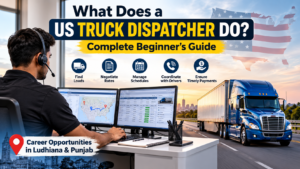
Truck dispatching is the process of coordinating freight transportation for a trucking company or motor carrier. A dispatcher helps identify suitable loads, communicates with freight brokers, negotiates rates on behalf of the carrier when authorized, coordinates pickup and delivery details, and monitors shipment progress.
In the US trucking industry, dispatchers help carriers keep their trucks moving while managing schedules, communication, and operational paperwork.
A truck dispatcher may work directly for a trucking company or provide dispatch services under an appropriate agreement with a carrier.
Key people involved in truck dispatching
-
Carrier: The trucking company or owner-operator responsible for transporting freight.
-
Dispatcher: The person who coordinates loads, communicates with brokers, and supports the carrier’s operations.
-
Load board: An online marketplace where available freight and truck capacity can be matched.
-
Freight broker: An intermediary that arranges transportation between shippers and carriers.
-
Driver: The person who operates the truck and physically transports the shipment.
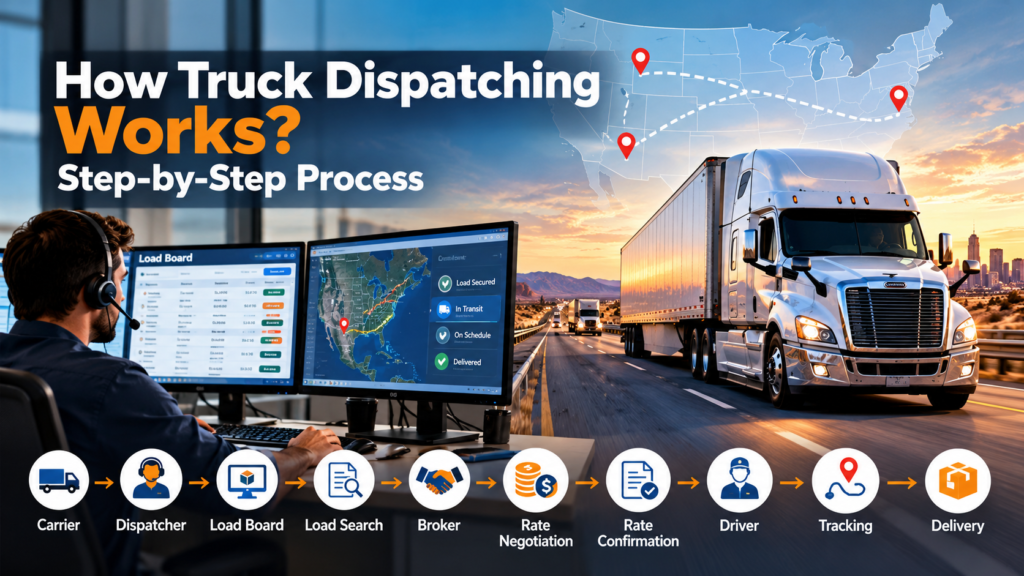
The carrier, dispatcher, broker, and driver each have different responsibilities. Understanding how they work together makes the entire truck dispatching process easier to learn.
-
Understand the carrier’s requirements.
-
Search for loads on a load board.
-
Identify a suitable load.
-
Contact the freight broker.
-
Negotiate the freight rate.
-
Review and confirm the load.
-
Coordinate with the driver.
-
Track the shipment.
-
Confirm delivery.
-
Complete the paperwork and payment process.
Let’s understand each step in detail.
Step 1: Understand the Carrier’s Requirements
Before searching for freight, a dispatcher needs to understand the carrier’s requirements and operating preferences.
This information helps the dispatcher find loads that match the truck’s equipment, location, availability, and business objectives.
Important details include:
-
Truck type, such as dry van, reefer, or flatbed.
-
Current truck location and expected availability.
-
Preferred pickup and delivery locations.
-
Maximum acceptable deadhead miles.
-
Preferred freight lanes and minimum rate expectations.
-
Driver schedule, available driving hours, and delivery constraints.
Example: Suppose a carrier operates a 53-foot dry van truck in Dallas, Texas. The dispatcher learns that the truck will be available tomorrow morning and that the carrier prefers loads moving toward Atlanta, Georgia.
The dispatcher can now search for freight that matches these requirements instead of wasting time on unsuitable loads.
This initial step helps make the entire US truck dispatching process more efficient.
Step 2: Search for Loads on a Load Board
A load board is an online platform where brokers and other freight providers post available shipments and carriers or their authorized representatives search for suitable loads.
Load boards commonly display information such as:
-
Pickup and delivery locations.
-
Available pickup dates.
-
Freight type and required equipment.
-
Shipment weight.
-
Posted rate, when available.
-
Broker contact information.
A dispatcher filters available loads according to the carrier’s requirements and reviews the most promising options.
Examples of load board platforms include DAT One and truck stop.
However, a load board listing is only the starting point. The dispatcher must verify the details, contact the broker, and confirm the commercial terms before the carrier commits to the shipment.
Step 3: Identify a Suitable Load
Finding an available load is not the same as finding a profitable load.
A dispatcher must evaluate whether the shipment makes sense for the carrier’s equipment, location, schedule, and operating costs.
Key factors include:
-
Deadhead miles: The distance the truck must travel without freight to reach the pickup location.
-
Loaded miles: The distance traveled while carrying the shipment.
-
Rate per mile: The agreed freight rate divided by the relevant mileage calculation.
-
Pickup and delivery appointments: Whether the truck can meet the scheduled times.
-
Equipment requirements: Whether the truck and trailer meet the shipper’s needs.
-
Route suitability: Whether the destination fits the carrier’s preferred lanes or next-load strategy.
For example, a load offering a higher total rate may be less attractive if it requires a long empty drive or takes the truck into a market with limited outbound freight.
A skilled dispatcher considers the overall trip rather than choosing a load based on the highest advertised price alone.
Step 4: Contact the Freight Broker
Once the dispatcher identifies a suitable load, the next step is to contact the freight broker.
A freight broker arranges transportation between the shipper and the motor carrier. The broker typically communicates the shipment requirements, discusses pricing, and coordinates the booking process with the carrier.
During the call or email exchange, the dispatcher may need to confirm:
-
Whether the load is still available.
-
Pickup and delivery dates and times.
-
Commodity type and shipment weight.
-
Pickup and delivery addresses.
-
Required equipment.
-
Loading and unloading arrangements.
-
Any special instructions or additional charges.
The dispatcher should also follow appropriate carrier and company procedures for checking the broker’s identity, authority, and reliability.
Clear communication at this stage helps prevent misunderstandings, delays, and unexpected costs.
Step 5: Negotiate the Freight Rate
Rate negotiation is one of the most important skills in truck dispatching.
The rate shown on a load board may be negotiable, or the broker may ask the carrier to provide a rate. The dispatcher communicates the carrier’s pricing expectations and attempts to secure commercially acceptable terms.
A dispatcher may consider:
-
Total mileage and deadhead distance.
-
Current market conditions.
-
Fuel and other operating costs.
-
Pickup and delivery urgency.
-
Equipment availability.
-
The carrier’s minimum acceptable rate.
Example of freight rate negotiation
Suppose a broker offers $1,800 for a shipment covering 900 loaded miles.
The dispatcher reviews the mileage, empty travel, and carrier requirements before discussing a higher rate.
| Item | Example |
|---|---|
| Broker’s initial offer | $1,800 |
| Dispatcher’s counteroffer | $2,100 |
| Final agreed rate | $2,000 |
| Loaded mileage | 900 miles |
| Gross rate per loaded mile | $2.22 |
In this example, the final rate per loaded mile is approximately $2.22, calculated as $2,000 divided by 900 miles.
This is a simplified example, not a current market benchmark. The rate per loaded mile also does not represent the carrier’s profit because operating expenses and empty miles may affect the final result.
The dispatcher should communicate the final offer to the carrier and obtain the required approval before committing to the load.
Step 6: Review the Rate Confirmation
After the carrier agrees to take the load, the broker generally sends a document called a rate confirmation, also known as a rate con.
This document records the agreed transportation terms for the specific shipment. It is an important part of the load booking process.
The dispatcher should check that the rate confirmation matches the agreed details, including:
-
Agreed freight rate.
-
Pickup and delivery addresses.
-
Appointment dates and times.
-
Commodity and weight.
-
Special handling requirements.
-
Detention, layover, or other accessory terms, where applicable.
-
Instructions for submitting delivery documents and requesting payment.
Any discrepancies should be resolved before the shipment proceeds. The carrier should follow its established authorization and signing procedures.
Why is this step important? Accurate documentation reduces confusion about the agreed rate, delivery requirements, and additional charges.
Step 7: Coordinate With the Driver
Once the load is confirmed, the dispatcher communicates the shipment details to the driver.
The driver needs clear instructions to reach the pickup location, complete the loading process, and deliver the freight within the agreed schedule.
The dispatcher typically shares:
-
Pickup and delivery addresses.
-
Appointment times.
-
Broker and customer contact details.
-
Shipment reference numbers.
-
Special loading or unloading instructions.
-
Relevant tracking and check-in requirements.
The dispatcher also confirms that the driver can meet the schedule and that the planned trip is compatible with applicable hours-of-service requirements.
For example, if the pickup appointment is at 8:00 AM, the dispatcher should ensure that the driver has enough time to reach the facility and complete any required check-in procedures.
Effective driver communication helps reduce missed appointments and avoidable delays.
Step 8: Track the Shipment

Shipment tracking allows the carrier and relevant parties to understand where the truck is, whether it is progressing according to schedule, and whether any issues need attention.
Common tracking responsibilities include:
-
Confirming that the driver has arrived at the pickup location.
-
Verifying that the freight has been loaded.
-
Collecting shipment status updates.
-
Monitoring estimated arrival times.
-
Communicating delays to the broker when required.
-
Coordinating responses to traffic, weather, or facility delays.
-
Confirming arrival at the delivery location.
Dispatchers may use phone calls, GPS tracking platforms, electronic logging device integration’s, or broker-provided tracking systems.
For instance, if a driver encounters a significant delay, the dispatcher can communicate the updated estimated arrival time to the broker and help coordinate the next steps.
Tracking is not simply about locating a truck. It is about maintaining accurate communication and managing delivery expectations.
Step 9: Confirm Delivery
The delivery stage is where the driver completes the transportation assignment at the destination.
The dispatcher may coordinate with the driver and broker to confirm that the truck has arrived, the shipment has been unloaded, and the delivery requirements have been completed.
Important delivery tasks include:
-
Confirming arrival at the delivery facility.
-
Monitoring unloading and appointment completion.
-
Reporting delays or discrepancies.
-
Obtaining the required delivery paperwork.
-
Confirming whether the shipment was delivered successfully.
If there is a shortage, damaged freight, a refused shipment, or another delivery issue, the driver and carrier should follow the appropriate reporting procedures and notify the relevant parties.
Successful delivery is a key milestone, but the dispatching process may not be complete until the required documentation has been submitted.
Step 10: Complete Paperwork and Payment Follow-Up
After delivery, the dispatcher or carrier’s back-office team helps ensure that the required shipment documents are collected and submitted.
Common documents include:
-
Bill of Lading (BOL): A document associated with the shipment and its transportation details.
-
Proof of Delivery (POD): Evidence that the shipment was delivered, often including a receiver’s signature.
-
Rate confirmation: The document recording the agreed load terms.
-
Freight invoice: The carrier’s invoice requesting payment for the transportation service.
The exact paperwork and submission requirements depend on the carrier, broker, shipment, and payment arrangement.
The carrier or its designated billing team submits the invoice and supporting documents according to the broker’s instructions. Payment is then handled under the applicable agreement, sometimes with the assistance of a factoring company.
A dispatcher may help follow up on missing documents or payment status, depending on the services provided.
Important: Accurate paperwork helps avoid preventable billing delays and supports a smoother transition from completed delivery to payment.
Complete US Truck Dispatching Process at a Glance
01
Carrier requirements
Understand the truck, equipment, location, and preferred lanes.
02
Load board search
Find available freight that matches the carrier’s needs.
03
Load evaluation
Review mileage, rate, appointments, and trip suitability.
04
Broker communication
Verify availability and confirm shipment details.
05
Rate negotiation
Discuss pricing and secure carrier approval.
06
Rate confirmation
Verify the agreed terms and complete booking procedures.
07
Driver coordination
Communicate pickup and delivery instructions.
08
Shipment tracking
Monitor progress and communicate status updates.
09
Delivery confirmation
Confirm unloading and report any exceptions.
10
Paperwork and payment
Submit required documents and follow up on billing.
What Skills Does a Truck Dispatcher Need?
Learning how truck dispatching works is the foundation. To perform the job effectively, a dispatcher also needs practical communication, coordination, and problem-solving skills.
The most useful skills include:
-
Load board management: Searching and filtering freight opportunities efficiently.
-
Rate negotiation: Communicating professionally with brokers and understanding the carrier’s pricing requirements.
-
US trucking terminology: Understanding terms such as deadhead, loaded miles, BOL, POD, rate con, detention, and layover.
-
Communication skills: Coordinating with drivers, brokers, and carrier representatives.
-
Time management: Monitoring appointments and managing competing priorities.
-
Basic computer skills: Working with spreadsheets, email, load boards, and transportation management systems.
-
Problem-solving: Responding to delays, missed appointments, and shipment-related issues.
-
Documentation: Reviewing load details and maintaining accurate records.
Practical training can help beginners understand how these skills fit together in a real dispatching workflow.
Can You Learn US Truck Dispatching From India?
Yes. You can learn the operational skills involved in US truck dispatching from India and prepare for relevant roles with trucking companies or dispatch service providers. Actual employment depends on your skills, experience, employer requirements, and work arrangements.
A structured learning plan should cover:
-
Fundamentals of the US trucking industry.
-
Carrier, broker, dispatcher, and driver responsibilities.
-
Types of trucks and freight.
-
Load boards and load searching.
-
Rate negotiation and rate confirmation.
-
Driver coordination and shipment tracking.
-
BOL, POD, invoicing, and documentation.
-
Practical dispatch scenarios and professional communication.
If your goal is to build a career in this field, prioritize hands-on practice over memorizing definitions. Practice finding a suitable load, calculating mileage, preparing questions for a broker, reviewing a sample rate confirmation, and communicating a delivery delay.
Also understand the regulatory boundaries of dispatch services. In the United States, whether a dispatch service needs broker authority depends on the nature of its activities and the applicable rules; the label “dispatcher” alone does not determine the requirement. Review the official FMCSA guidance on brokers and bona fide agents for further information.
Frequently Asked Questions (FAQs)
1. How does truck dispatching work in the USA?
Truck dispatching involves finding suitable freight, communicating with brokers, negotiating rates, confirming load details, coordinating drivers, tracking shipments, and supporting delivery documentation and payment follow-up.
2. What is the role of a truck dispatcher?
A truck dispatcher coordinates freight transportation on behalf of a carrier or trucking company. Responsibilities may include load searching, broker communication, rate negotiation, driver coordination, shipment tracking, and paperwork.
3. What is a load board in truck dispatching?
A load board is an online marketplace that helps match available freight with trucks that need shipments. It typically displays load locations, equipment requirements, dates, and other shipment details.
4. What is a rate confirmation in US trucking?
A rate confirmation is a document that records the agreed terms for a particular shipment, including the transportation rate, pickup and delivery details, and applicable conditions.
5. What is the difference between a truck dispatcher and a freight broker?
A truck dispatcher generally coordinates loads on behalf of a carrier under an appropriate working arrangement. A freight broker arranges transportation between shippers and carriers. The legal distinction depends on the actual activities and applicable regulations.
6. Can beginners learn US truck dispatching?
Yes. Beginners can learn the fundamentals through structured instruction and practical exercises covering load boards, freight terminology, rate negotiation, driver communication, shipment tracking, and documentation.
7. How long does it take to learn truck dispatching?
The time required depends on your starting knowledge, training quality, and practice. You may learn the basic workflow relatively quickly, but developing confidence in rate negotiation, load evaluation, and real-world problem-solving takes additional practice.
8. Is truck dispatching a good career option in India?
It can be a career option for people interested in logistics operations, communication, and US trucking workflows. Career opportunities and earnings vary according to employer, experience, role, and market demand; training does not guarantee employment.
Conclusion: Understand the Process, Build Your Logistics Skills
Understanding how truck dispatching works gives you a practical foundation for learning the US trucking industry. From searching for loads and negotiating rates to tracking shipments and completing delivery paperwork, each step contributes to efficient freight transportation.
The key is to understand not only what each step means, but also how the carrier, dispatcher, broker, and driver work together throughout the shipment life cycle.
With structured learning, practical exercises, and a strong understanding of US trucking terminology, beginners can develop the skills needed to pursue relevant opportunities in logistics and dispatch operations.
Ready to Learn US Truck Dispatching?
If you want to build practical knowledge of load boards, rate negotiation, driver coordination, and freight documentation, explore professional logistics training and start developing your dispatching skills.
Explore USA Logistics Training in Ludhiana and take the next step toward understanding real-world US trucking operations.