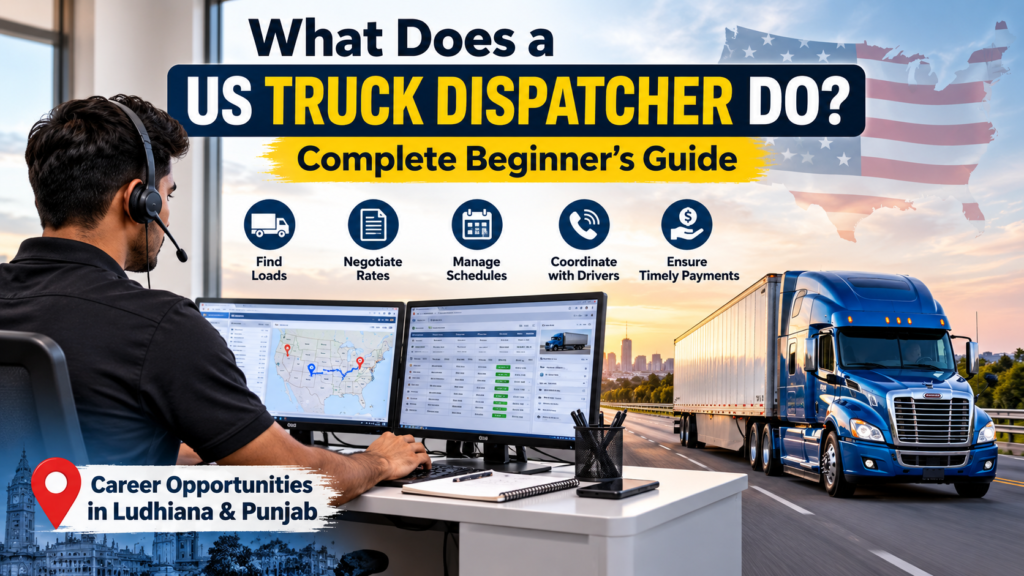
If you are exploring a career in the US logistics industry from Ludhiana or anywhere in Punjab, you may have come across the term truck dispatcher.
But what exactly does a truck dispatcher do?
A truck dispatcher plays an important role in the day-to-day operations of a trucking business. From finding suitable loads and communicating with brokers to coordinating schedules and keeping track of shipments, dispatchers help keep trucks moving and operations organized.
The role has also attracted attention among people in India who want to work with US-based trucking operations remotely.
In this beginner’s guide, we’ll explain what a truck dispatcher does, how US truck dispatching works, what skills you need, what a typical dispatcher does during the day, and how someone from Ludhiana or Punjab can explore this career path.
What Does a Truck Dispatcher Do?
A truck dispatcher coordinates between truck drivers, trucking companies, brokers, shippers and other parties involved in transporting freight.
In simple terms, a dispatcher helps a trucking company answer questions such as:
- Where should the truck go next?
- Which load should the truck take?
- What rate is available for the load?
- When does the load need to be picked up?
- Where does it need to be delivered?
- What paperwork is required?
- What should happen if there is a delay?
The exact responsibilities vary depending on the trucking company and its operating model.
For a US truck dispatcher, the work typically involves understanding the US freight market, communicating with brokers and drivers, finding loads, negotiating rates where applicable, and coordinating the movement of trucks.
How Does Truck Dispatching Work?
To understand what does a truck dispatcher do, it helps to understand the basic dispatching process.
A simplified truck dispatching workflow looks like this:
Find Load → Check Load Details → Contact Broker → Negotiate Rate → Confirm Load → Send Information to Driver → Track Shipment → Handle Updates → Complete Documentation
Let’s look at these steps individually.
1. Finding Loads
One of the important responsibilities of a dispatcher is searching for suitable freight for available trucks.
Dispatchers may use freight marketplaces and other industry resources to identify loads based on factors such as:
- Truck type
- Current truck location
- Destination
- Pickup time
- Delivery time
- Distance
- Freight requirements
- Available rate
The dispatcher needs to consider whether a load makes operational and financial sense for the trucking company.
2. Checking Load Details
Finding a load is only the beginning.
Before accepting a load, the dispatcher needs to review important information such as:
- Pickup location
- Delivery location
- Pickup appointment
- Delivery appointment
- Commodity
- Weight
- Distance
- Equipment requirements
- Rate
- Special instructions
Carefully checking these details can help reduce avoidable problems during transportation.
3. Communicating With Brokers
A dispatcher frequently communicates with freight brokers.
Communication may involve asking about:
- Load availability
- Pickup and delivery details
- Rate
- Appointment times
- Commodity
- Equipment requirements
- Detention or layover policies
- Required documents
Professional communication is therefore an important skill for a US truck dispatcher.
4. Negotiating the Rate
Depending on the dispatcher’s role and the company’s business arrangement, the dispatcher may negotiate the freight rate with a broker.
The objective is to secure appropriate freight for the truck while considering factors such as:
- Mileage
- Market conditions
- Deadhead miles
- Fuel costs
- Driver availability
- Pickup and delivery requirements
- Overall profitability
Rate negotiation is one reason that understanding the US trucking market can be valuable for someone entering truck dispatching.
5. Sending Load Information to the Driver
Once a load is confirmed, the dispatcher communicates the relevant information to the driver.
This can include:
- Pickup address
- Delivery address
- Appointment times
- Broker information
- Load number
- Commodity details
- Weight
- Special instructions
Clear communication is essential because the driver needs accurate information to complete the trip.
6. Tracking the Load
The dispatcher’s job doesn’t necessarily end after the truck leaves for pickup.
The dispatcher may continue monitoring the shipment and communicating with the driver.
For example, the dispatcher may need to know:
- Has the driver reached the pickup?
- Was the truck loaded?
- Has the truck departed?
- Is the truck on schedule?
- Has the driver reached delivery?
- Is there a delay?
This helps the trucking company maintain communication throughout the shipment.
7. Handling Delays and Problems
Transportation doesn’t always go according to plan.
A truck may experience:
- Traffic
- Weather-related delays
- Mechanical problems
- Appointment changes
- Loading delays
- Delivery delays
- Detention
A dispatcher may communicate with the driver, broker and other parties to coordinate an appropriate response.
This is why problem-solving and communication skills are important for a truck dispatcher.
What Does a Truck Dispatcher Do Every Day?
A typical dispatcher’s day can involve several activities rather than one repetitive task.
A dispatcher may spend time:
Morning
- Checking available trucks
- Reviewing driver schedules
- Searching for loads
- Contacting brokers
During the day
- Booking freight
- Negotiating rates
- Sending load information
- Tracking trucks
- Communicating with drivers
- Updating brokers
Throughout operations
- Managing delays
- Checking appointments
- Organizing paperwork
- Following up on deliveries
The exact routine depends on the trucking company’s fleet size, freight type, operating region and dispatching process.
Skills Required to Become a US Truck Dispatcher
You don’t necessarily need to be a professional truck driver to work in dispatching.
However, you need to develop several practical skills.
1. Communication Skills
A dispatcher communicates with drivers, brokers and trucking companies regularly.
Good communication should be:
- Clear
- Professional
- Concise
- Timely
2. English Communication
Because US truck dispatching involves communication with US-based trucking industry professionals, practical English communication is useful.
You should be comfortable with:
- Phone conversations
- Emails
- Text messages
- Professional terminology
- Basic business communication
For beginners in Ludhiana and Punjab, improving spoken and written English alongside dispatching knowledge can be useful when preparing for this type of work.
3. Negotiation Skills
Dispatchers may negotiate freight rates depending on their responsibilities and company setup.
Understanding how to communicate value and discuss rates professionally can become an important part of the job.
4. Time Management
Trucking operates around pickup and delivery schedules.
A dispatcher may have to manage multiple trucks and shipments simultaneously.
Good time management helps with:
- Appointment tracking
- Load planning
- Driver communication
- Follow-ups
- Documentation
5. Basic Computer Skills
Modern dispatching involves working with digital tools.
A beginner should be comfortable with:
- Web browsers
- Spreadsheets
- Online load platforms
- Digital documents
- Communication software
6. Problem-Solving
Unexpected situations are common in transportation.
A dispatcher needs to assess the situation, communicate with the appropriate people and help coordinate the next step.
What Is a US Truck Dispatcher?
A US truck dispatcher is a dispatcher who supports trucking operations connected to the United States freight market.
The dispatcher may work with:
- Trucking companies
- Owner-operators
- Drivers
- Freight brokers
- Shippers
The job involves coordinating freight movement and helping ensure that trucks have appropriate loads and schedules.
Some dispatch operations can be performed remotely, which is one reason the field has attracted interest from professionals outside the United States, including people exploring US logistics careers from India.
Is Truck Dispatching a Good Career Option for Beginners?
Truck dispatching can be an entry point into the broader logistics and transportation industry, but beginners should understand that it is a professional operational role—not simply a matter of finding loads online.
A successful dispatcher needs to understand:
- US trucking terminology
- Freight movement
- Load types
- Equipment
- Rate concepts
- Broker communication
- Driver communication
- Documentation
- Appointment scheduling
- Dispatching software and online tools
Practical training can help beginners understand these processes before entering the industry.
How Can Someone From Ludhiana Become a US Truck Dispatcher?
For someone in Ludhiana, the first step is to understand how the US trucking and freight system works.
A practical learning path can look like this:
Step 1: Learn US Trucking Basics
Understand:
- Truck types
- Trailers
- Freight
- Routes
- Miles
- Pickup and delivery
- Brokers
- Shippers
- Carriers
- Owner-operators
Step 2: Learn Truck Dispatching
Learn the complete dispatching workflow, including load searching, broker communication, booking, driver coordination and tracking.
Step 3: Develop Communication Skills
Work on professional English communication, particularly phone conversations and business terminology.
Step 4: Learn Dispatching Tools
Become familiar with the types of platforms and digital tools used in US trucking operations.
Step 5: Practice Realistic Scenarios
Practice situations such as:
- Calling a broker
- Asking about a load
- Discussing a rate
- Confirming pickup information
- Updating a driver
- Handling a delay
Step 6: Explore Entry-Level Opportunities
Once you have developed practical knowledge, you can explore dispatcher positions, logistics companies and other US trucking support roles.
Truck Dispatcher Jobs in Ludhiana and Punjab
Ludhiana has a strong business and industrial ecosystem, and people looking to enter logistics-related careers may encounter opportunities connected to domestic as well as international operations.
For someone searching online for a truck dispatcher job in Ludhiana, it is useful to search beyond the exact job title.
Related terms can include:
- US truck dispatcher
- Truck dispatcher
- Freight dispatcher
- Dispatch executive
- Logistics executive
- US logistics executive
- Trucking operations executive
- Dispatch coordinator
People elsewhere in Punjab can use the same approach when searching for opportunities.
What Is the Salary of a Truck Dispatcher?
There is no single fixed salary for a truck dispatcher.
Compensation can vary depending on:
- Experience
- Employer
- Location
- Shift
- Responsibilities
- Number of trucks handled
- Communication skills
- US trucking knowledge
- Compensation structure
Some dispatch roles may also have performance-based or commission-related components.
Therefore, beginners should evaluate the complete job structure rather than assuming a particular salary simply from the job title.
Is a Truck Dispatching Course Necessary?
A formal course is not the only way to enter the field, but structured training can help beginners learn the workflow systematically.
A relevant truck dispatching course in Ludhiana may cover areas such as:
- US trucking fundamentals
- Truck and trailer types
- Load boards
- Load searching
- Broker communication
- Rate negotiation
- Rate confirmation
- Driver coordination
- Dispatch documentation
- Tracking
- Practical dispatch scenarios
When evaluating a US dispatch course in Ludhiana, beginners should look for practical training rather than choosing a course solely based on advertising claims.
Why Are People in Punjab Exploring US Logistics Careers?
The growth of digital communication and remote work has made it possible for some logistics support functions to be performed from outside the US.
This has created interest in areas such as:
- US truck dispatching
- Freight operations
- Logistics support
- Documentation
- Back-office trucking operations
For people in Ludhiana and Punjab, US logistics can therefore be one area worth researching when considering careers connected with international transportation operations.
However, the actual requirements and opportunities vary between employers, so candidates should verify job descriptions and company requirements before making career decisions.
Final Thoughts
Understanding what a truck dispatcher does is the first step for anyone considering this career.
A dispatcher is essentially a coordination point between different parts of the trucking operation. The role can involve finding loads, communicating with brokers, coordinating drivers, managing schedules, tracking shipments and handling operational problems.
For beginners in Ludhiana and Punjab, learning the fundamentals of US trucking and gaining practical knowledge of truck dispatching can provide a foundation for exploring opportunities in the wider logistics industry.
If you’re considering a truck dispatcher job, don’t focus only on the job title. Build practical knowledge, improve your communication skills, understand the US trucking system and learn how real dispatch operations work.