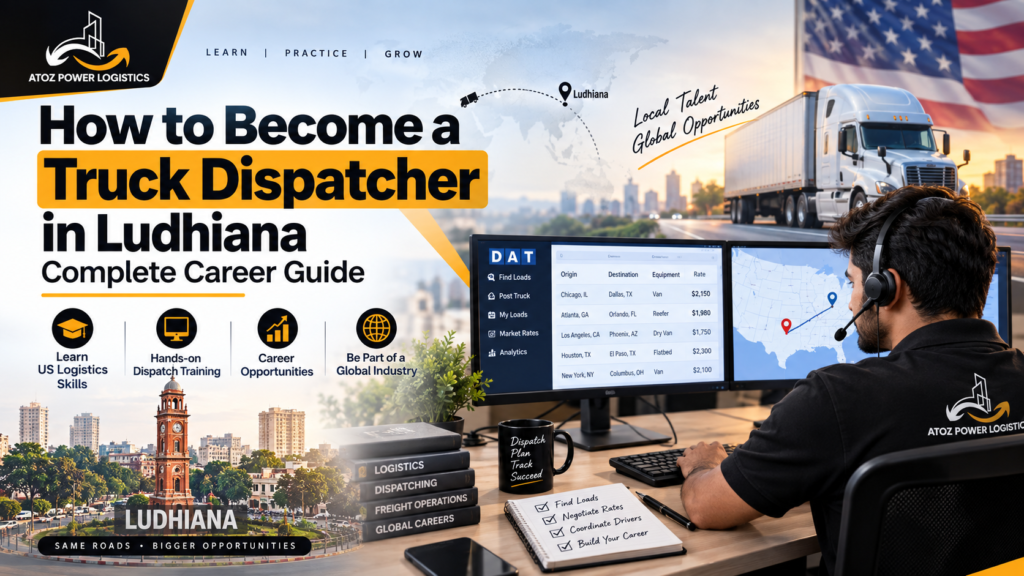
The US trucking and logistics industry depends on efficient coordination between carriers, drivers, brokers and customers. One of the important roles in this process is the truck dispatcher.
For people in Ludhiana who are interested in logistics, transportation, customer support or international operations, truck dispatching can be a career path worth exploring.
But how do you actually become a truck dispatcher in Ludhiana?
You need more than just the ability to find loads online. A professional US truck dispatcher needs to understand load boards, freight operations, broker communication, rate negotiation, dispatch paperwork, driver coordination and basic US trucking regulations.
This guide explains how to become a truck dispatcher in Ludhiana, what skills you need, what training can help, which tools dispatchers use and what career paths you can explore after learning US truck dispatching.
What Is a Truck Dispatcher?
A truck dispatcher coordinates freight operations on behalf of a motor carrier or trucking company.
In a typical US trucking operation, a dispatcher may help:
- Find suitable loads
- Search freight on load boards
- Contact freight brokers
- Negotiate rates
- Coordinate pickup and delivery information
- Communicate with drivers
- Track loads
- Manage dispatch-related paperwork
- Monitor changing schedules
- Help resolve operational issues
DAT describes truck dispatchers as professionals who locate and book freight for carriers, communicate with brokers, negotiate rates and coordinate drivers and routes.
In simple terms, the dispatcher acts as an important communication and operations link between the carrier, driver and freight marketplace.
Why Learn Truck Dispatching in Ludhiana?
Ludhiana has a strong connection with manufacturing, transportation, business services and industrial activity. This makes logistics-related skills relevant for students, freshers and professionals looking to enter the sector.
However, US truck dispatching is different from simply working in a local transportation office.
A person working with US logistics needs to understand how the American trucking ecosystem operates, including:
- US trucking terminology
- OTR operations
- Load boards
- Freight brokers
- Carrier operations
- Rate confirmations
- Pickup and delivery appointments
- Driver communication
- Hours-of-service basics
- ELD concepts
- Freight documentation
This is why structured truck dispatch training in Ludhiana can be useful for someone who wants to learn the workflow before entering the industry.
How to Become a Truck Dispatcher in Ludhiana
There is no single educational path that every truck dispatcher must follow. The practical route is to learn the industry, develop dispatching skills and gain experience with real-world workflows.
Here is a step-by-step roadmap.
Step 1: Understand the US Trucking Industry
Before learning load booking, understand the environment in which a dispatcher works.
Start with concepts such as:
- Motor carriers
- Owner-operators
- OTR trucking
- Drayage
- Freight brokers
- Shippers
- Load boards
- Dispatch services
- Trucking equipment
- Freight lanes
You should understand how a shipment moves from the shipper through the transportation process and ultimately reaches its destination.
This foundation makes it easier to understand why a dispatcher makes particular decisions when selecting and booking loads.
Step 2: Learn What a Truck Dispatcher Does
The next step is understanding the actual responsibilities of a dispatcher.
A typical workflow can include:
Search Loads → Evaluate Loads → Contact Broker → Negotiate Rate → Book Load → Send Information to Driver → Track Shipment → Complete Documentation
A dispatcher may also need to respond quickly when circumstances change.
For example, a driver may experience:
- Traffic delays
- Appointment changes
- Mechanical problems
- Loading delays
- Delivery issues
- Changes in route
That means dispatching is not only about finding loads. It is also a communication, coordination and problem-solving role.
Step 3: Learn Load Boards
Load boards are an important part of US truck dispatching.
They allow logistics professionals to search for available freight according to factors such as:
- Pickup location
- Delivery location
- Equipment type
- Load availability
- Distance
- Freight requirements
- Pickup and delivery dates
DAT is one of the major load-board platforms used within the freight industry.
Learning how to search and evaluate loads is therefore an important part of becoming a US truck dispatcher. DAT’s dispatcher guide also highlights load-board knowledge as a core part of learning the profession.
What should you learn on a load board?
You should understand how to:
- Search for available freight
- Filter loads
- Check pickup and delivery locations
- Identify suitable equipment
- Compare load options
- Review mileage
- Evaluate the offered rate
- Contact brokers
- Gather load information
- Decide whether a load fits the carrier’s requirements
Step 4: Learn How Load Booking Works
Finding a load is only one part of dispatching.
A dispatcher must understand the process of communicating with the broker and confirming the shipment details.
Before booking a load, a dispatcher should understand important information such as:
- Pickup address
- Delivery address
- Pickup date and time
- Delivery date and time
- Commodity
- Weight
- Equipment requirements
- Miles
- Rate
- Detention terms
- Special instructions
- Broker information
Accuracy matters because mistakes in load information can create operational problems for the carrier and driver.
Step 5: Develop Broker Communication Skills
Communication is one of the most important skills for a truck dispatcher.
Dispatchers regularly communicate with brokers and drivers, often while managing multiple tasks.
You should learn how to:
- Introduce yourself professionally
- Ask for load details
- Confirm availability
- Discuss rates
- Ask relevant operational questions
- Communicate professionally by phone and email
- Follow up with brokers
- Handle objections
- Maintain professional relationships
Good communication is especially important when working with US-based clients and brokers.
For someone in Ludhiana, this can also mean becoming comfortable with professional English communication and US business terminology.
Step 6: Learn Freight Rate Negotiation
Rate negotiation is another important dispatching skill.
A dispatcher should not simply accept the first rate offered by a broker without understanding the load and the carrier’s requirements.
You should learn to consider:
- Total mileage
- Pickup and delivery locations
- Equipment
- Market conditions
- Deadhead
- Timing
- Load requirements
- Carrier preferences
The goal is to understand the economics of the load and communicate professionally with the broker.
Rate negotiation should be based on information and the carrier’s requirements rather than simply trying to obtain the highest possible number.
Step 7: Understand Rate Confirmation and Freight Documents
Once a load is booked, documentation becomes important.
A beginner in truck dispatching should become familiar with documents and terminology such as:
- Rate Confirmation
- Bill of Lading (BOL)
- Proof of Delivery (POD)
- Carrier setup documents
- Insurance documents
- Invoices
- Load information
Understanding these documents helps a dispatcher communicate accurately with carriers, brokers and other parties involved in the shipment.
This is one reason practical truck dispatch training in Ludhiana can be useful: students can learn the workflow rather than only memorizing logistics terminology.
Step 8: Learn Basic US Trucking Compliance
You do not need to become a transportation lawyer to work as a dispatcher, but you should understand basic compliance concepts relevant to the operations you support.
Important areas include:
- Hours of Service (HOS)
- Electronic Logging Devices (ELDs)
- Driver availability
- Equipment requirements
- Basic FMCSA terminology
- Carrier information
- Safety and operational requirements
FMCSA is the US federal agency responsible for regulating important aspects of commercial motor carrier safety and related transportation operations.
A dispatcher should understand enough about these concepts to avoid making operational decisions without considering the driver’s available hours and other requirements.
Step 9: Learn Dispatch Software and Communication Tools
Modern dispatch operations involve more than a phone and a spreadsheet.
Depending on the company, dispatchers may work with:
- Load boards
- Transportation Management Systems (TMS)
- GPS/tracking systems
- VoIP calling systems
- Messaging platforms
- Digital documentation
- Driver communication tools
Industry guides also identify load boards, dispatch software and transportation-management tools as common parts of modern dispatch workflows.
You do not necessarily need to master every software platform before starting.
Instead, focus on understanding the workflow behind the tools.
Step 10: Choose the Right Truck Dispatcher Training
Self-learning is possible, but beginners can find the US trucking ecosystem confusing because it includes many terms, systems and processes.
A structured truck dispatcher course in Ludhiana can help organize the learning process.
When comparing training programs, look for practical coverage of:
US Logistics Fundamentals
Understand the US trucking ecosystem and major participants.
OTR Operations
Learn how long-haul trucking operations work.
Load Boards
Understand how to search and evaluate available freight.
Load Booking
Learn how dispatchers communicate with brokers and book loads.
Rate Negotiation
Understand freight rates, mileage and negotiation fundamentals.
Driver Coordination
Learn how dispatchers communicate with drivers throughout a trip.
Documentation
Understand rate confirmations, BOLs, PODs and other important paperwork.
ELD and HOS Basics
Learn the terminology and operational importance of driver hours and electronic logging.
Career Preparation
Develop communication, interview and practical dispatching skills.
The objective should be to build job-ready operational knowledge, rather than simply collecting a course certificate.
What Skills Do You Need to Become a US Truck Dispatcher?
A successful dispatcher needs a combination of technical, communication and organizational skills.
1. Communication Skills
You will communicate with drivers, brokers and other logistics professionals.
Clear communication is essential.
2. Negotiation Skills
You should understand how to discuss rates professionally and evaluate whether a load is suitable.
3. Time Management
Dispatchers may manage multiple loads, drivers and conversations at the same time.
4. Problem-Solving
Transportation does not always go according to plan. Delays and operational issues require quick responses.
5. Computer Skills
You should be comfortable using browsers, email, spreadsheets, load boards and logistics software.
6. Attention to Detail
Small errors in addresses, dates, rates or documentation can create significant operational problems.
7. English Communication
Because US truck dispatching involves communication with US-based brokers, carriers and drivers, professional English communication can be an important skill.
Do You Need a Degree to Become a Truck Dispatcher?
There is no single degree that qualifies someone to become a truck dispatcher.
The specific requirements can vary depending on the employer and position.
For many entry-level roles, practical knowledge of trucking operations, communication skills, computer skills and familiarity with dispatching workflows can be important.
This makes truck dispatching a potential career area for:
- Graduates
- Freshers
- Career switchers
- Customer support professionals
- Logistics students
- Transportation professionals
- People interested in US logistics
Instead of focusing only on a degree, beginners should focus on developing practical US logistics and dispatching skills.
Is Truck Dispatching the Same as Freight Brokerage?
No.
This is an important distinction for anyone entering US logistics.
A truck dispatcher generally works on behalf of a carrier, while a freight broker acts as an intermediary between shippers and motor carriers.
FMCSA defines a broker as a party that arranges transportation between shippers and motor carriers without operating the vehicles itself.
DAT similarly explains that dispatchers work on behalf of carriers, while brokers occupy a different role in the freight transaction.
The legal distinction can depend on what a dispatch service actually does. Anyone planning to operate an independent dispatch business should review applicable FMCSA guidance and obtain appropriate professional/legal advice rather than assuming that completing a course automatically determines their regulatory status.
What Career Opportunities Are Available After Truck Dispatch Training?
After learning US truck dispatching, possible career paths can include roles such as:
- Truck Dispatcher
- Freight Dispatcher
- Logistics Coordinator
- Dispatch Executive
- Transportation Coordinator
- Freight Operations Executive
- Customer Support Executive in Logistics
- Carrier Support Executive
The exact job title and responsibilities vary between companies.
Some people may work directly for a trucking company, while others may work with logistics service providers or dispatch operations.
Can You Learn US Truck Dispatching From Ludhiana?
Yes, training for US logistics operations can be undertaken in Ludhiana.
The important factor is not simply the location of the classroom. The training should expose learners to the actual workflow used in US trucking operations.
A practical learning path should cover:
US Logistics → Trucking Basics → OTR → Load Boards → Load Searching → Broker Calls → Rate Negotiation → Load Booking → Driver Coordination → Documentation → ELD/HOS Basics
This gives learners a structured understanding of how the different parts of dispatching connect.
A Simple Roadmap to Become a Truck Dispatcher in Ludhiana
If you are starting from zero, you can follow this roadmap:
Phase 1 — Learn the Basics
Understand:
- US trucking
- Logistics terminology
- OTR
- Drayage
- Carriers
- Brokers
- Shippers
- Equipment types
Phase 2 — Learn Dispatching
Practice:
- Load-board searches
- Load evaluation
- Broker communication
- Rate negotiation
- Load booking
- Driver coordination
Phase 3 — Learn Documentation
Understand:
- Rate confirmations
- BOL
- POD
- Carrier setup
- Invoices
- Dispatch paperwork
Phase 4 — Learn Compliance Basics
Study:
- HOS
- ELD
- FMCSA terminology
- Driver availability
- Basic operational compliance
Phase 5 — Practice Real Workflows
Practice complete scenarios from:
Finding a Load → Calling the Broker → Negotiating → Booking → Sending Information → Tracking → Completing Documentation
Phase 6 — Prepare for Employment
Build:
- Resume
- Communication skills
- Interview skills
- Practical knowledge
- Logistics terminology
- Confidence with dispatch software and tools
Why Practical Training Matters
Reading about truck dispatching can help you understand the terminology, but logistics is an operational field.
The real challenge is knowing what to do when multiple things happen simultaneously.
For example:
A driver becomes available → you search for a load → find a suitable shipment → call the broker → negotiate the rate → confirm the load → check pickup information → communicate with the driver → track the shipment → handle updates.
Understanding this complete workflow is more useful than simply memorizing definitions.
That is why beginners should look for training that combines US logistics theory with practical dispatching workflows.
Learn US Logistics and Truck Dispatching in Ludhiana
If your goal is to build practical knowledge of US logistics and truck dispatching, ATOZ Power Logistics offers a dedicated Logistics Course in Ludhiana covering areas such as US logistics, OTR and drayage operations, load booking, DAT search, customer and driver support, and career preparation.
The course is designed around practical US logistics workflows and is intended for freshers, career starters and professionals looking to develop logistics skills.
Explore the ATOZ Power Logistics Logistics Course in Ludhiana:
Logistics Course in Ludhiana
Frequently Asked Questions
How can I become a truck dispatcher in Ludhiana?
Start by learning US trucking and logistics fundamentals, followed by load boards, load booking, broker communication, rate negotiation, documentation and basic compliance concepts. Practical training can help you understand the complete dispatch workflow.
Is truck dispatching a good career option for freshers?
Truck dispatching can be an entry point into logistics for people who develop the required communication, computer, organizational and US trucking knowledge. Job requirements vary by employer.
Do I need previous logistics experience to learn truck dispatching?
Not necessarily. Beginners can learn the fundamentals through structured training and practical exercises. A basic understanding of computers and professional communication can be helpful.
What is taught in a truck dispatcher course in Ludhiana?
A practical program may cover US logistics, OTR operations, load boards, DAT search, load booking, rate negotiation, broker communication, driver coordination, documentation and basic ELD/HOS concepts.
What is a US truck dispatcher?
A US truck dispatcher coordinates freight operations on behalf of a carrier. Responsibilities can include finding loads, communicating with brokers, negotiating rates, booking freight, coordinating drivers and managing dispatch-related information.
Is a truck dispatcher the same as a freight broker?
No. A dispatcher generally represents a carrier, while a freight broker acts as an intermediary between shippers and carriers. The regulatory distinction depends on the actual activities performed.
Can I learn US truck dispatching from India?
Yes. Training can be completed in India, including Ludhiana, for people who want to develop skills related to US trucking operations. However, the quality of training depends on whether it teaches practical US logistics workflows rather than only theory.
What skills are important for a truck dispatcher?
Important skills include communication, negotiation, time management, attention to detail, computer skills, problem-solving and knowledge of US trucking operations.
Final Thoughts
Learning how to become a truck dispatcher in Ludhiana starts with understanding that dispatching is more than searching for loads.
A professional dispatcher needs to understand the complete process — from identifying suitable freight and communicating with brokers to negotiating rates, booking loads, coordinating drivers and managing documentation.
If you are starting from zero, focus on building practical knowledge step by step:
Learn US Logistics → Learn Trucking → Learn Load Boards → Practice Dispatching → Develop Communication Skills → Understand Documentation → Practice Real Workflows → Prepare for a Logistics Career
For structured practical training, explore the Logistics Course in Ludhiana by ATOZ Power Logistics.

